Git 3.0 is the Git project's next planned breaking-version boundary, but the official documentation says there is no planned release date yet. The current plan changes the default hash for new repositories from SHA-1 to SHA-256, makes main the default initial branch, requires Rust for builds, and makes reftable the default reference back-end. Because the plan is a living document, treat these as current project decisions rather than a shipped release.
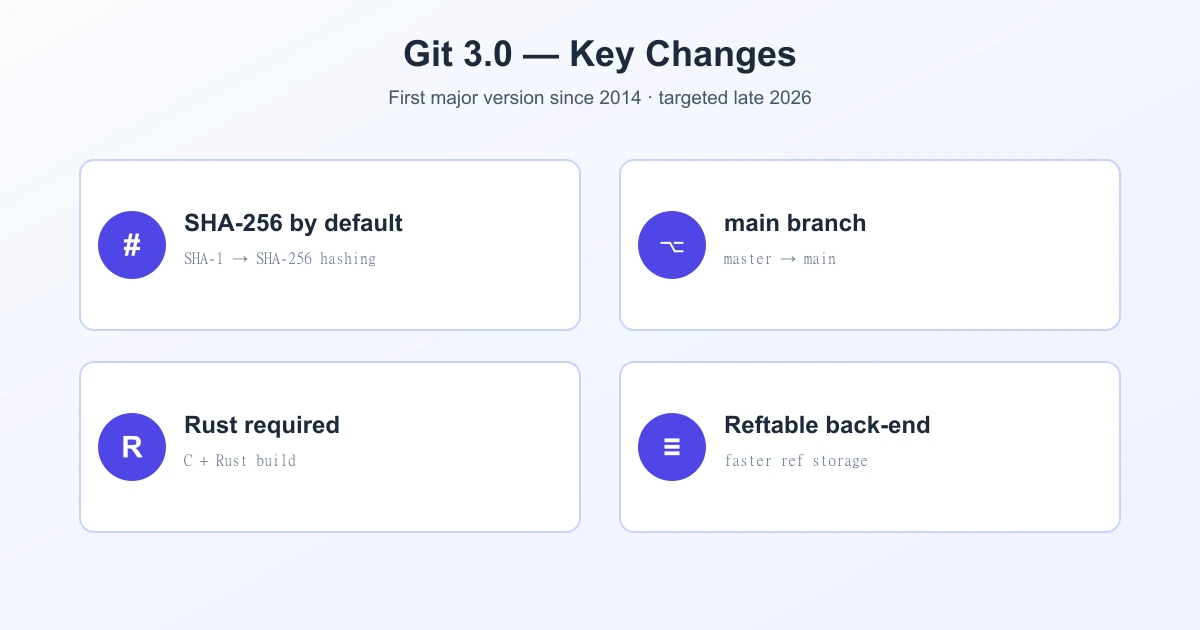
What Is Changing in Git 3.0
| Change | From → To | Why |
|---|---|---|
| Hash algorithm | SHA-1 → SHA-256 | Security — SHA-1 was deprecated by NIST in 2011 |
| Default branch | master → main | Inclusive-language standard already common in practice |
| Build requirement | C only → C + Rust | Memory safety for new components |
| Ref back-end | files → reftable (new repos) | Faster, more reliable reference storage |
The Big One: SHA-256 by Default
Every object in Git — every file, commit, and tree — is named by a hash of its content. Since day one, that hash has been SHA-1. The problem is that SHA-1 is old and cryptographically weak; the US National Institute of Standards and Technology (NIST) deprecated it back in 2011, and researchers have since demonstrated real collision attacks.
Git 3.0 makes SHA-256 the default for new repositories. Practically, existing SHA-1 repos keep working, but new ones will use the stronger hash. Recent releases have been laying the groundwork — Git 2.51, for example, added more of the preparations needed for the switch.
Why It Matters
For most day-to-day users, commits and diffs will look and behave exactly as before — the change is under the hood. But the shift matters for a few real reasons:
- Security. SHA-256 removes a long-standing weakness in how Git identifies content, which matters for supply-chain trust.
- Tooling. Anything that reads Git's object hashes — CI systems, code hosts, and diff or comparison tools — has to understand 64-character SHA-256 hashes, not just 40-character SHA-1 ones.
- Scripts and habits. Renaming the default branch to
mainand adding Rust to the build will affect setup scripts, Docker images, and CI pipelines that assumedmasteror a C-only toolchain.
What Happens Next
The Git project's BreakingChanges manual does not name a release date. It also says ecosystem readiness is a prerequisite for both SHA-256 object format and reftable defaults. That includes alternative Git implementations, libraries, applications and hosting services. Avoid planning a production migration around an unofficial calendar estimate.
If you maintain tooling that reads object IDs, branch defaults or reference storage, test the work-in-progress behaviour and watch the official manual for changes. Existing SHA-1 repositories are not scheduled for removal, so ordinary users do not need to convert repositories pre-emptively.
Does This Change How Diffs Work?
No. Git 3.0 changes how objects are named and stored, not how differences between them are computed. The diff you see still comes from the same line-matching logic — by default the Myers algorithm, with histogram and patience available as options. If you want the full picture of how Git turns two snapshots into the coloured output you read, see how git diff works under the hood. SHA-256 changes the labels on the boxes; it does not change how Git compares what is inside them.
Frequently Asked Questions
When is Git 3.0 coming out?
The Git project has not announced a planned release date. Its BreakingChanges manual documents the current Git 3.0 plan and the ecosystem prerequisites, but explicitly describes the document as living guidance.
What is the biggest change in Git 3.0?
The switch from SHA-1 to SHA-256 as the default hash for new repositories. SHA-1 has been considered weak since NIST deprecated it in 2011, so SHA-256 improves security.
Will Git 3.0 break my existing repositories?
The current plan keeps SHA-1 support and applies the SHA-256 default to newly created repositories. Tool maintainers should test assumptions about 40-character object IDs, master, the files ref backend and C-only builds. Regular users should wait for an actual release and their host's compatibility guidance.
Why does Git 3.0 require Rust?
Git 3.0 makes Rust a mandatory build requirement to bring memory safety to newer components. The long-standing C codebase remains, but new parts can be written in Rust.
Can I use SHA-256 repos on GitHub?
Do not assume full interoperability. Before creating a SHA-256 repository for shared work, check the current documentation for your hosting provider and every tool in the workflow. The Git project lists ecosystem readiness as a prerequisite for changing the default.
Does Git 3.0 change how git diff works?
No. It changes how Git hashes and stores objects, not how it computes differences. Git diff still uses the Myers algorithm by default, with histogram and patience as alternatives.
Sources
Related Reading
Compare Code Versions Instantly
No repo needed — paste two versions of any file or code and see a clean, word-level diff in seconds. Free and private.
Try TextCompareo